“So many memories brought to mind.”

— Margo, South Surrey

Pender Islands Historical Timeline

Step back through the centuries and explore the rich history of Pender Island, from its earliest prehistoric roots to the vibrant community we know today. This interactive timeline lets you journey across key moments, uncover stories of the people and places that shaped the islands, and connect with the heritage that continues to inspire us. Use the filters to browse by year, explore distinct periods, or search by keyword to dive deeper into the events that matter most to you.
Select a period

Select a year

Enter Keyword

Use these filters to narrow down your entry results.

Showing: 126 - 150 of 338 entries
  1. 1958

    Electricity Arrives

    Electricity comes to part of North Pender in 1956. By 1958 most residents have signed up for the long-awaited service and begin to acquire electrical appliances.

  2. 1958

    “The Knolls” Dismantled

    The Hamilton family home, “The Knolls,” built in 1900 at Port Browning, is dismantled.

  3. 1958

    Provincial Ferry Authority

    Premier W.A.C. Bennett announces on July 18 that the British Columbia Ferry Authority will take over passenger and car ferry service.

  4. 1958

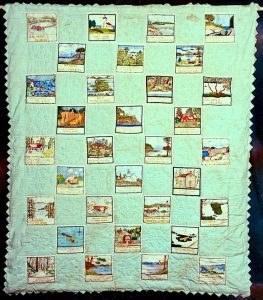
    Patchwork Quilt Raffle

    A patchwork quilt is raffled to raise money to offset the cost of publishing A Gulf Islands Patchwork, the first book to record the memoirs and stories of settler era arrivals on the Gulf Islands. The quilt is returned in 1991, and remains on display in the Pender Islands Museum.

  5. 1957

    First Archaeological Dig

    The first professional archaeological excavation is carried out at the Pender Canal Site by the BC Provincial Museum. During 1957-58, two test pits probe the main middens north and south of the bridge.

  6. 1956

    Brackett House Demolition

    The 1898 settler home built by the Brackett family at Port Browning is torn down.

  7. 1956

    “Cy Peck” Converted

    The ship Cy Peck is converted to carry motor cars, marking a major change in transportation options for islanders.

  8. 1956

    Cannonball Found

    Cecily Reynolds unearths a cannonball in her yard. It likely came from a Royal Navy 68-pound cannon fired during practice in the last half of the 19th century. (The cannonball is in the museum.)

  9. 1956

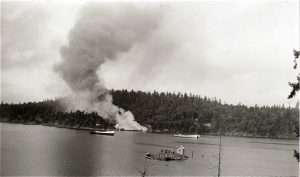
    Saltery Destroyed by Fire

    The saltery in Hayashi Cove in Otter Bay is destroyed by fire and ceases operation.

  10. 1955

    Ferry Service Subsidized

    The BC Government begins to subsidize ferry service.

  11. 1955

    Corbett Sells Store

    Percy Corbett sells the Hope Bay Store to Ralph Smith, but stays on as Postmaster. The Corbetts had run the store for 50+ years.

  12. 1955

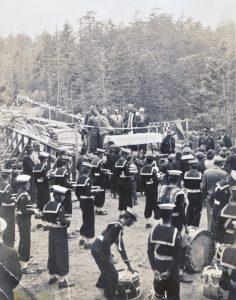
    Canal Bridge Opens

    Construction of the North & South Pender sections of Canal Road are completed and connected with a single-lane bridge over the canal. The bridge is officially opened on June 1, finally linking the two islands created in 1903 by the dredging of the canal.

  13. 1954

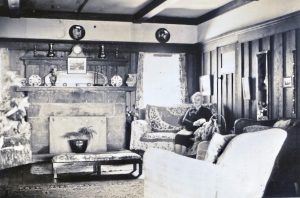
    Death of Elizabeth Grimmer

    Elizabeth Grimmer dies on Good Friday at her “Lisson Grove“ home at Port Washington at age 76. Her granddaughter, Nora, described how the 1920s house “shone with a love of beautiful things. English china mingled with Chinese urns and Indian brassware. Vases of flowers graced the polished wood tables and Rosewood piano. Her family were her pride and pleasure.” Lisson Grove was demolished in 2022 after falling into disrepair.

  14. 1952

    Waterlea Becomes Private Home

    Waterlea ceases to be a resort and becomes a private residence once again.

  15. 1952

    “Island Princess” Ferry

    The ferry Island Princess is running between the mainland at Steveston and the Gulf Islands.

  16. 1951

    Death of Lilias Spalding

    Lilias Spalding (neé Mackay) dies at age 81. She came to South Pender in 1889 as the 19-year-old bride of Arthur Spalding. She took a leading role in community affairs, serving as longtime Post Mistress and School Trustee. There were few important social occasions in which she was not directly involved, and she left a remarkable legacy.

  17. 1951

    Death of Dr. Aldridge

    Dr Augustus Aldridge dies. Although he never sought a licence to practice medicine in Canada, he had served in WWI, retired with his wife Mary to their property by the canal on North Pender, and helped out in medical emergencies. Fittingly, the Pender Island Health Centre is now located on Aldridge land.

  18. 1951

    Port Browning Wharf

    The Port Browning Government wharf is built.

  19. 1950

    Death of Albert Menzies

    Albert Hugh Menzies dies in 1950 at age 93. He had arrived on North Pender in 1893 with his family, and was one of the best farmers on the island, boasting a prize Jersey dairy herd.

    Dates from the family's time in Manitoba before coming to BC.
  20. 1950

    “Old-Timers” Gathering

    A gathering of Gulf Island “Old-Timers” is held on May 15 on Salt Spring Island. Pender is well-represented.

  21. 1950

    Roesland Rentals

    As many as 17 cabins are available for summer rental at Roesland, and the Roes discontinue farming operations.

  22. 1950

    Spalding House Razed

    The original Spalding farm house on South Pender is razed. The location is now Lilias Spalding Park.

  23. 1948

    Menzies Retires

    Victor Menzies sells his farm to Ashton Ross-Smith and retires from farming. The farmhouse is left unoccupied, with much of the lumber re-used in building the Hope Bay Bible Camp.

  24. 1947

    Fish Plant Re-opens

    The fish reduction plant re-opens at Shingle Bay after an earlier fire.

  25. 1947

    Hotel Destroyed by Fire

    In June, the Grosvenor House Hotel at Port Washington is destroyed by fire.